↳ Workflow illustration · review states, not a running task or measured result.
ADDITIONAL IMPLEMENTATION EXAMPLES
Explore the technical work.
ApplicationsThis portfolioMy own responsive website: clear content, directly linked services, and a scroll-driven visual composition.+
I built this site with server-rendered content, validated publishing data, accessible HTML, and optional graphics. Mobile layouts, keyboard navigation, reduced motion, and graphics fallback are part of the implementation. This is my own web project, not a client engagement.
Live site · continued development
AutomationNEON StudioQueued AI media workflows with persisted jobs, checks, retries, human review, and export.+
Generation is one step in a larger workflow. The studio coordinates queued work and makes uncertain outputs available for review. Latest quality checks still need representative acceptance tests.
In development
SystemsAudio Unification ProtocolAudio routing across endpoints, with reconciliation, calibration, remote inputs, and desktop/mobile clients.+
Routes audio to multiple endpoints around the house, reconciles endpoint state, supports calibration and remote inputs with consent, and has desktop and Android clients. It runs as a master on my home server with nodes on several machines. Synchronization is approximate, not sample-accurate; Bluetooth and Chromecast latency vary.
Running at home; in development
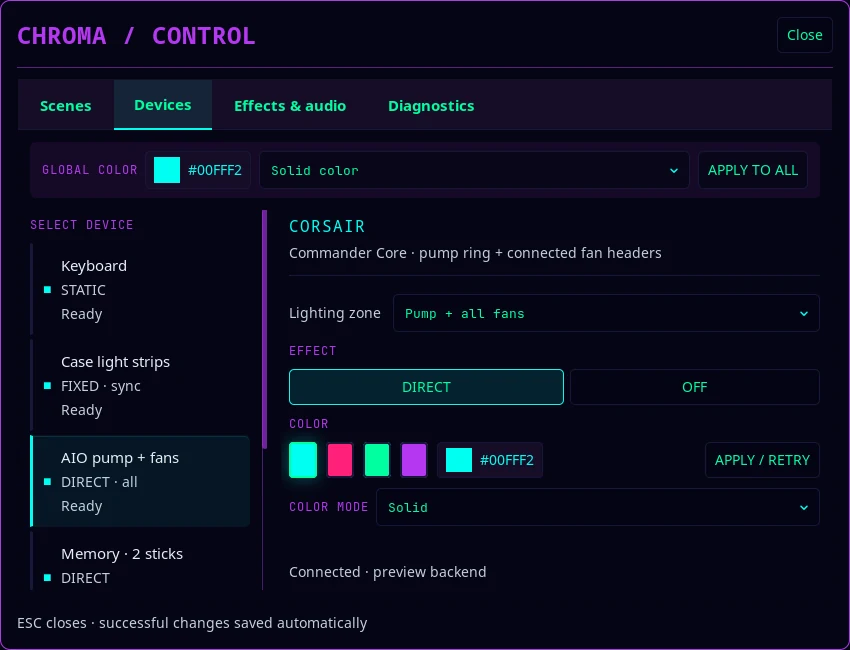
SystemsChroma ControlLayered RGB effects, independent zones, and paced output across device backends, including OpenLight.+
Independent output workers coalesce frames and pace device writes. The interface brings scenes and zones together. The existing capture below shows a preview backend, not proof of physical-device output.
SystemsStasisA Linux diagnostics dashboard connecting resource use to processes, services, and applications.+
Separate metric and process-sampling paths support a dashboard that helps identify what is using resources. Current telemetry accuracy and live control behavior still need verification.
In development
ApplicationsRGTabletopCollaborative browser maps with shared state, tokens, and guest-demo infrastructure.+
Live map operations and token movement are coordinated with persistence and guest provisioning. Real-time authorization and durable-save failure handling need further hardening.
In development
AutomationVoice, text & local AIDesktop assistant interfaces and routing between local and cloud backends, with user-controlled fallback.+
A voice assistant I use at home: wake-word listening on shared audio feeds, speech recognition and a synthesized voice on a home server, with routing between local and cloud models. Recent work added voice identities with per-person preferences and limits for guests. Room detection and phone background listening are not implemented.
In development
ApplicationsDocument utilitiesControlled spreadsheet revisions, formula and style checks, and generated Word/PDF documents.+
Purpose-built utilities limit edits and check unchanged formulas, styles, and document structure. These are specialized workflows, not a general accounting or document-validation product.
Implemented; demonstration pending
SystemsWorkstation toolsDevice discovery, desktop automation, service lifecycle controls, and targeted upstream compatibility work.+
My own Linux workstation configuration and utilities cover software setup, device discovery, desktop automation, and service lifecycle controls. Local extensions and compatibility patches build on upstream software. Configuration remains partly host-specific; this is development and setup evidence, not a customer support history.
Ongoing development
ApplicationsHome Control Protocol (HCP)A browser control deck for the house: lights, scenes, audio zones and voice on one map, usable from desktop, phone and a wall touchscreen.+
A dependency-free Node web app that serves the interface and holds the lighting gateway token server-side, so browsers never see it. Covers a house map, scenes, lighting sync to a chosen audio source, audio routing, a PIN-gated guest mode and voice-identity enrollment. A Debian touchscreen kiosk shows it full-screen. It is a single-household tool, not a multi-tenant product.
Running at home; in development
SystemsHome server & networkA Debian home server I installed and run: containers, private networking, remote unlock, and a written rebuild procedure.+
Debian Stable on a repurposed PC, reachable over Tailscale with remote disk-unlock over SSH, running the lighting gateway, HCP and the audio master in Docker. Service data is kept in RAM with periodic saves to disk, hardware faults (a flaky SATA link) were diagnosed and worked around, and a RESTORE document records how to rebuild it. This is my own household infrastructure, not a client engagement.
Running; ongoing
ApplicationsTerminal art launcherA Rust terminal app for browsing, installing and rotating terminal art, with workspace presets for Arch Linux.+
A ratatui interface that discovers installed terminal art programs, shows descriptions, saves favorites and applies workspace layout presets. Includes an installer, tests and an Arch package recipe; it is not yet published to the AUR. Arch Linux only.
Released; public repository
HAVE A SIMILAR TECHNICAL NEED?
Let’s discuss your workflow.
We can use the relevant approach as a starting point and agree on a scope that fits your situation.